About Chatham Historic Dockyard
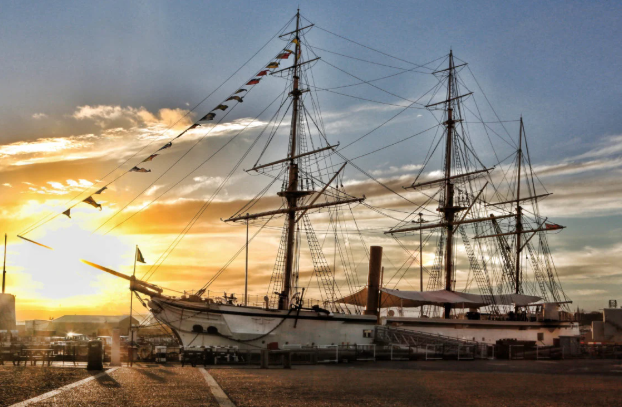
The Chatham Historic Dockyard is a world-leading maritime heritage destination managed by The Chatham Historic Dockyard Trust, a registered charity set up in 1984 following the closure of the Royal Dockyard at Chatham, which marked the end of over 400 years of shipbuilding on the River Medway.
The charity employs over 140 people, aiming not only to set the benchmark in maintaining excellence in the sympathetic preservation and use of The Historic Dockyard and its buildings, ships and collections, but also to engage the widest possible audiences in learning about the significance and history of the former Royal Dockyard.
The reuse of Chatham Historic Dockyard is diverse and includes attractions including three historic warships, providing retail and catering services, commercial and residential property, with over 100 businesses located on the site and over 400 people who refer to the site as ‘home’, plus the manufacture of marine rope.
As a place of learning, it provides a place for over 600 people to study with the University of Kent, and the stunning and historic venues provide the perfect place for a wedding venue or a film set for award winning films and series.

The Challenge
In response to the move away from traditional ‘on -premise, legacy’ finance systems, software providers are investing their development resources in revolutionising the ERP space, none more so than Microsoft with their market leading Dynamics Business Central solution delivered alongside the Microsoft AI Business Solutions stack.
Consequently in September 2024, Microsoft announced a timeline for the ‘End of Life’ of Microsoft Dynamics Great Plains and advising customers to move to Microsoft Dynamics Business Central.
Chatham Historic Dockyard Trust was one of those progressive organisations who already recognised that running an administration and gaining insight into the operations of an organisation with such diverse activities was an arduous task.
Their existing systems (including Microsoft Great Plains) were difficult to integrate, meaning that analysing performance and efficiencies across the various entities and operations was being done through spreadsheets, emails and many ‘bits of paper’. On a large site, this process took time to collate and carried the risk of inaccurate data.
Finding a solution that was cloud based, that would be able to integrate with other systems, could utilise multi-dimensional accounting to categorise the huge variety of transactions and provide all this in real time in one system accessible to more than just the finance team was a project that was firmly on the agenda.
The Solution
Chatham Historic Dockyard Trust looked at a number of options as a solution for their ERP, including Microsoft Dynamics Business Central delivered by Nolan Business Solutions.
Despite having originally implemented the Microsoft Dynamics Great Plains solution, Nolan approached this project in the same way that they would approach any new ERP system review. Lead consultant, Neil De Villiers, pointed out the importance of focusing on alleviating the frustrations created from using a legacy system, the opportunities that were available to transform time intensive processes and identifying the data insights required to help inform the trust’s strategy and performance moving forward.
Nolan carried out a number of meetings, both remote and on-site, to fully understand the requirements of the trust and the challenges that would be presented to an ERP project by such varied activities and business processes. The solution was scoped, breaking the project down into bite sized phases with initial demonstrations conducted to help the Trust understand how the depth of functionality with Business Central and the familiarity of the Microsoft solutions together with the integration throughout the wider Microsoft stack all made Business Central the natural choice and Nolan, already a trusted partner, were the implementation partner who understood the both short and medium term requirements and objectives.
_jneth.png)
The Process
Like many organisations undertaking this business transformation, the team at Chatham were in a position that they ‘didn’t know what they didn’t know’ and were not sure what questions to ask throughout the process.
Right from the project kick off meeting, Nolan’s dedicated Project Management function, led by Phoebe Allen, provided clarity and support to the team at Chatham Historic Dockyard Trust that enabled them to prepare effectively for key workshops and data migrations and ensured the Nolan consultant were able to make the most efficient use of our client facing time to gain the information and data needed to configure and build the new finance system.
Sean Rodwell, Director of Finance and Resources at Chatham Historic Dockyard Trust, said that regular meetings with Phoebe and lead consultant, Neil De Villers, really helped to keep the project on track, on time and on budget and ensure ‘Go Live’ was delivered on its target date.
_oddbw.png)
The Outcome
Whilst still in the early days of life with Business Central, Chatham Historic Dockyard are seeing the benefits of better financial control, more automated processes and the potential to expand that automation in the future. They are also starting to rely less on all of those multiple spreadsheets.
Phase two of the project will start shortly with a ‘post implementation review’ to understand what went well, what areas of the system require further tweaking and how further control and data insights can be obtained.
One of the key areas of priority is to extend the power of Business Central’s ‘Purchase to Pay’ process by implementing Nolan’s eRequest software - a solution that enhances Business Central with a purchase requisition and spend control process to help provide oversight and governance of spend across the whole organisation.
_vpvir.png)
